Go (Golang) Development

145+
5,0

Webdelo is a technology partner for mid-sized and large businesses (B2B). We have been developing systems using the Go programming language since 2018. Our team consists of 50+ professionals.

Our development team specializes in creating high-load applications with horizontal scaling and minimal response latency. We design architectures consisting of small, independent components (microservices) based on an Event-Driven Architecture (EDA) approach for markets in Russia, Germany, the USA, and other countries.

Send Request
trend ERP and CRM Integration

Automation of business processes, centralized data storage, and seamless integration of complex systems.

Blue magnifying glass icon on a light-blue background — audit SEO and AI-Ready

Project readiness for SEO promotion on Google and Yandex, as well as an architectural foundation for integration with LLMs and AI agents.

Coral eye icon centered on a pale pink circle 50+ Professionals

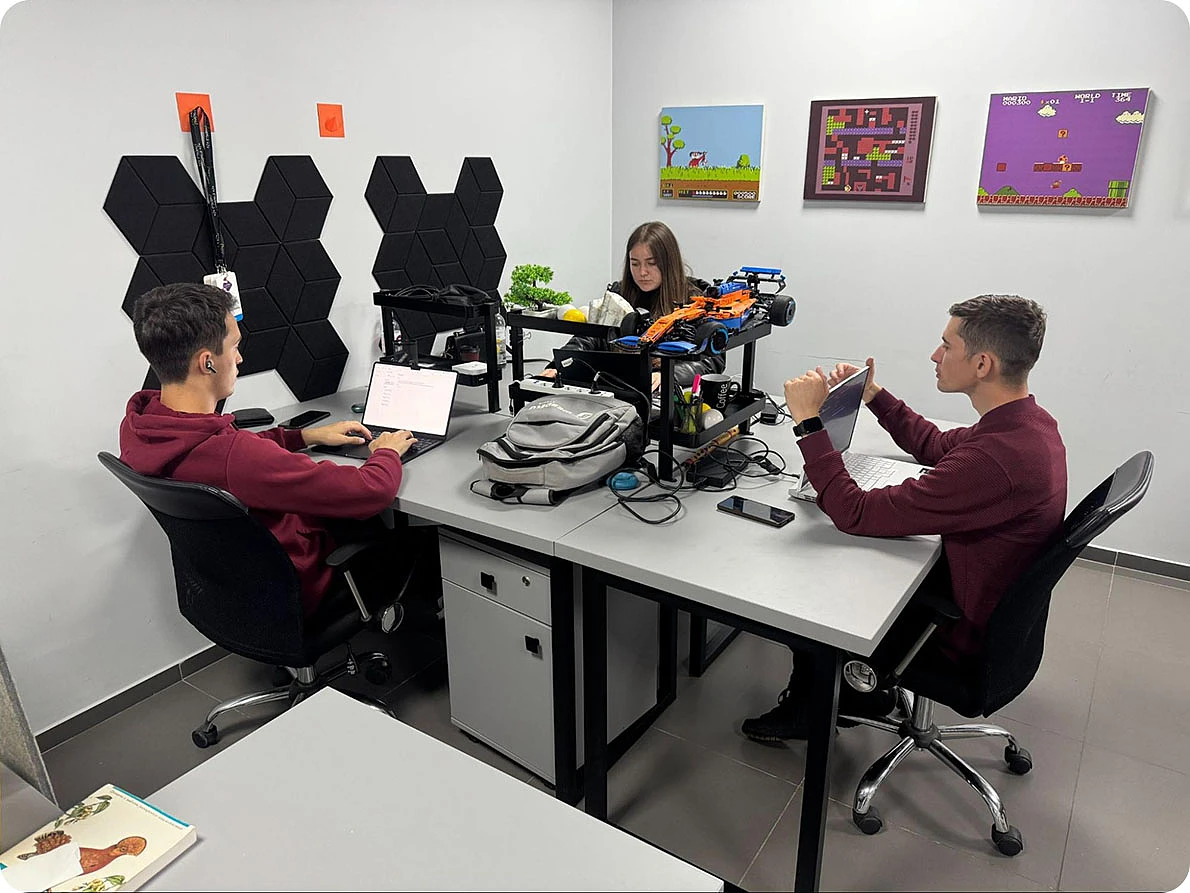
Our team consists of specialized in-house engineers — we handle projects without outsourcing to third parties or intermediaries.

Andrei Jumatii, Webdelo founder and marketing director, and Timofey Kabanov, operations coordinator, outdoors Personal Meeting

We are happy to arrange an in-person meeting when detailed technical discussions or contract signings are required.

Advantages

Advantages of Go for Your Business

Choosing the right technology determines a product’s reliability, performance, and long-term maintenance costs. Our web development company recommends Go for businesses in Russia that require speed, scalability, and reliability.

Yellow award icon with a medal and star inside a circle
High Execution Speed

The performance of written systems is comparable to C++ programs.

Blue security shield icon with a checkmark inside a circle
Code Reliability

Strict typing and an accelerated compilation process reduce the number of critical errors.

Purple node diagram or branching icon inside a circle
Server Resource Efficiency

The language efficiently manages memory and CPU power under high loads.

trend
Rapid Project Development

The hiring threshold for developers is lower than for C++, which speeds up team assembly and the start of development.

Technologies

Tech Stack and Tools

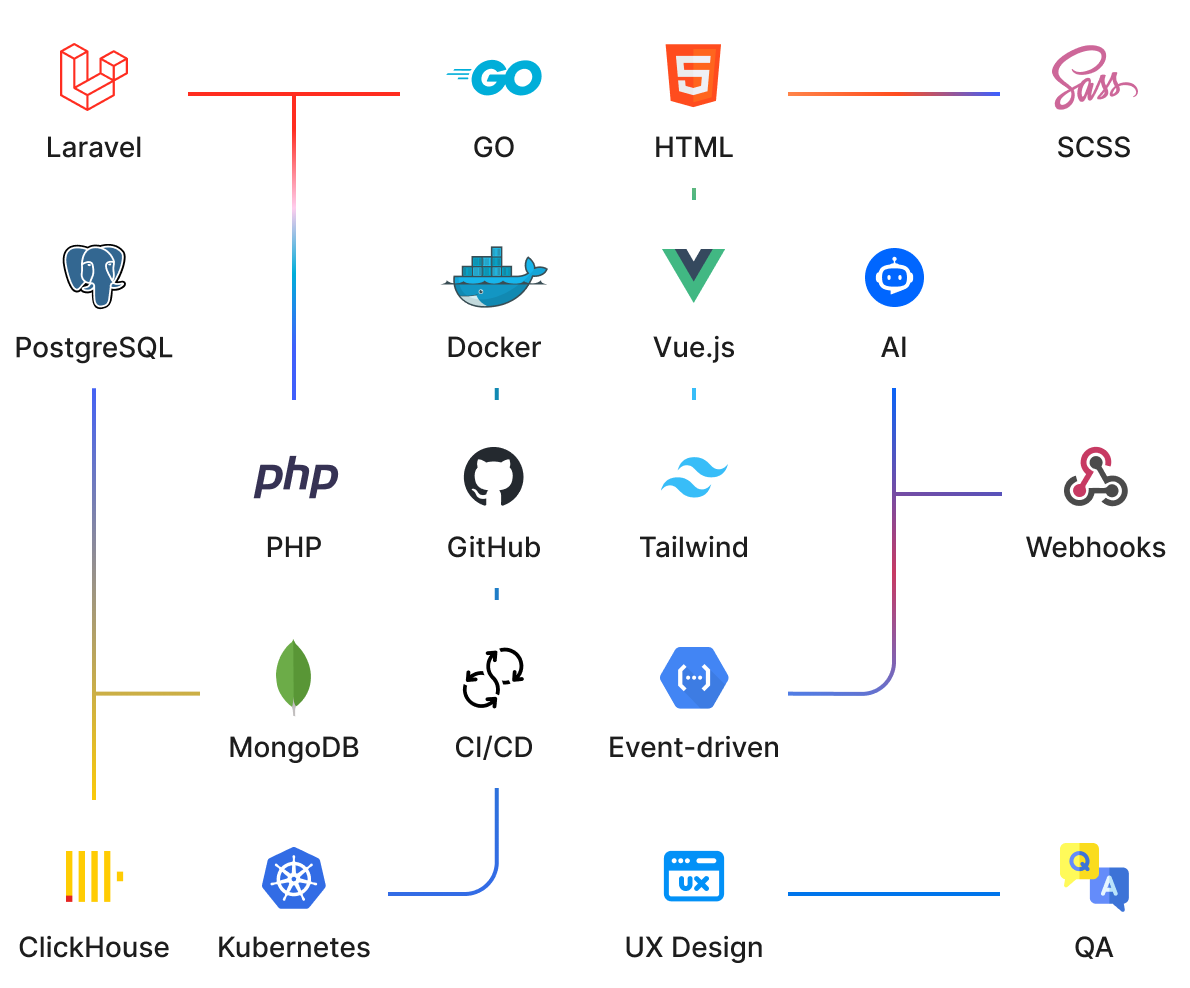
We use a proven set of modern technologies to implement our projects. This allows us to build a reliable architecture for both the backend and frontend, while ensuring uninterrupted infrastructure operation and convenient monitoring.
Backend
Go and PHP programming languages. The Laravel (PHP) framework is used for lightweight projects requiring rapid development.
Frontend
TypeScript, Vue.js, Angular.
Databases
PostgreSQL, MongoDB, ClickHouse.
Message Brokers
Kafka is used for heavy data streams, and RabbitMQ for specific task queues.
Infrastructure
Docker, Kubernetes, CI/CD tools.
Observability
Metric visualization and system log collection tools (Grafana, ELK stack, Logstash). We monitor CPU load, memory usage, event streams, and errors for each application in real time.
Services

Our Go Development Services

We offer full-cycle software development to solve complex technological challenges in the corporate sector. Our expertise covers the design, development, implementation, and support of fault-tolerant systems built to keep pace with rapidly evolving business requirements. We follow our proven development approach and methodologies while maintaining a high level of security and compliance throughout the project lifecycle.
MVP Development for Startups
We launch products built on the 12-factor app methodology principles. This allows the infrastructure to scale as the user base grows without rewriting the architecture.
Microservices Architecture Design
We build systems where microservices communicate via message brokers, consume events, and produce new events with processed data. We utilize Clean Architecture and Domain-Driven Design (DDD) approaches.
High-Load Systems Creation
Our team ensures pipeline processing of massive data streams. We optimize systems for strict external rate limits, preventing blocks from third-party services.
API Development and Integration
We implement modern data transfer standards (gRPC, Protocol Buffers) for internal service communication. For data exchange with external clients, web panels, and mobile apps, we use the classic REST architectural style.
Migration to Golang
We migrate legacy code from other languages. Webdelo specialists successfully rewrite systems from PHP to Go to remove speed bottlenecks in financial and trading services.
Cloud-Native Application Development
We package all applications into isolated execution environments (Docker containers). Projects are deployed in container orchestration systems (Kubernetes) when economically justified.
AI Integration
We use Go to integrate smart assistants (AI agents) where instant reaction is required. Architectural solutions proposed by artificial intelligence are strictly reviewed by a technical lead, following the Human-in-the-loop principle.
System Modernization
We update outdated systems and optimize business logic. The company takes a mindful approach that avoids over-engineering, offering only the infrastructure justified by the project's budget.
golang1
Security

Security and Compliance

Protecting corporate information and user data is our absolute priority. We embed high security standards at the system design stage and strictly follow international legal and technical regulations throughout the product lifecycle.

Personal Data Protection

For projects in Russia, we comply with Federal Law No. 152-FZ on Personal Data.
Process Standards

Information security management is built around international ISO 27001 and SOC 2 standards.
Legal Protection

Upon the client's request, we sign a Non-Disclosure Agreement (NDA) and a Data Processing Agreement (DPA) before starting work.

We apply the principle of least privilege: only necessary specialists have access to the production environment, and all actions are securely logged.

Industries

Industry Expertise

Since 2006, Webdelo has successfully delivered hundreds of projects for clients across various business sectors. Our team has a deep understanding of niche-specific details, allowing us to create projects that deliver real value and solve specific industry challenges.

Collaboration

How to Hire a Go Developer?

To ensure seamless integration with your internal business processes, we provide flexible engagement models. Finding and retaining strong Go (Golang) talent can be a major bottleneck for corporate projects, so we offer ready-made engineering resources. Whether you want to fully delegate the development of a complex system or scale your in-house team to accelerate delivery, you can choose the model that best fits your management style, budget, and risk profile.
Project Outsourcing (Managed Delivery)
We take responsibility for the entire software delivery lifecycle — from business analysis and architecture design to deployment and post-release SLA support. In this model, we assign a dedicated Tech Lead and Project Manager, develop the architecture, prepare the technical specifications, and deliver a turnkey solution. This is the ideal option when you have a clear business objective but want to delegate technical execution and delivery risks to an experienced technology partner.
Staff Augmentation (Outstaffing)
We integrate our Middle and Senior Go engineers directly into your existing IT department. Our developers adapt to your security policies, participate in Agile ceremonies, and work within your established processes and task management systems. Strategic direction, architecture decisions, and task prioritization remain under your control, while we handle recruitment, payroll, retention, and professional development.
Dedicated Team
We assemble a dedicated, cross-functional engineering team focused exclusively on your product. In addition to Go developers, the team can include DevOps engineers, QA specialists, business analysts, and other experts depending on your project requirements. The team operates as a long-term extension of your organization, developing deep domain knowledge and adapting efficiently to changing business needs without the overhead of building an internal department from the ground up.
Learn more about our delivery models, project workflows, and collaboration approach in the Delivery section.
Stages

How We Work: Golang Project Development Stages

Process transparency is the foundation of trust between a client and a technical partner. We use a clear, documented development cycle that allows you to control every step, from the first meeting to deploying the product into the production environment.

Stage 1

Data layer

Timeframe: 1–2 weeks

We identify product goals and finalize architectural decisions before starting development.

Stage 2

Design

Timeframe: 2–4 weeks

Engineers create the system architecture, interface prototypes, and database structure.

Stage 3

Development

Timeframe: sprints of 1–2 weeks (2–4 months for MVP)

Work is done in short iterations. Every code change undergoes a mandatory Code Review by a lead developer.

Stage 4

Testing

Timeframe: parallel to dev + 1–2 weeks for final checks

Programmers write automated tests to verify functions. The Quality Assurance (QA) department is fully involved.

Stage 5

Release

Timeframe: 1–3 days

The project is deployed to the production environment via an automated CI/CD system. A rollback plan is created for critical changes.

Stage 6

Support

Timeframe: continuous (SLA response: 15–20 mins)

We monitor system stability, promptly resolve incidents, and implement planned improvements.

Prices

Cost of Go Development

The project budget depends on the level of specialists involved, architecture complexity, and desired delivery timelines. Below is an outline of how different team roles affect the final product price and the tasks they cover.

Project Role Tasks Estimated Cost
Technical Lead (Team Lead) System design, communication tool selection, code review, and architectural decision logging. from $60 / hour
Lead Developer (Middle/Senior) Writing system business logic, creating microservices and data exchange interfaces. from $50 / hour
Infrastructure Engineer (DevOps) Configuring servers, Docker containers, load balancers, and automated CI/CD pipelines. from $50 / hour
Quality Engineer (QA) Conducting manual and automated load testing, checking security and functionality. from $35 / hour

(The final estimate is provided after an initial analysis and the preparation of a technical specification)

We understand that every project is unique, so we offer flexible engagement and pricing models. The choice depends on the maturity of the technical requirements, the complexity of your business domain, and how frequently priorities may change during development.

Fixed Price: A traditional model for projects with clearly defined requirements, a fixed scope of work, and detailed technical specifications.
Time & Material: Suitable for Agile projects where development is ongoing and priorities are adjusted regularly throughout the project lifecycle.
FAQ

Frequently Asked Questions (FAQ)

We have compiled answers to our clients' most frequently asked questions. If you do not find the information you need below, we will be happy to consult with you personally and review your project requirements in detail.

1. Why is Go development more expensive than PHP?
The Go language is commonly used to build complex, high-load distributed systems. Developing efficient solutions for these environments requires engineers with a deep understanding of runtime behavior, concurrency, and memory management, which raises the level of expertise required. We still use PHP for simpler websites and applications where it is the most practical choice.
2. How quickly can you start a project?
Every project begins with architecture analysis and requirements gathering. The start date for development depends on the project scope, resource availability, and the completion of necessary documentation, including a Non-Disclosure Agreement (NDA) when required.
3. What is the difference between outsourcing and staff augmentation (outstaffing)?
With outsourcing, we take responsibility for project management, technical planning, delivery, and final results. With staff augmentation, we provide engineers with the required qualifications, while project management, prioritization, and day-to-day development oversight remain under your control.
4. How do you ensure code quality?
Our company follows a structured quality assurance process. Every code change undergoes a mandatory review by a Technical Lead. In addition, we use automated testing to reduce the risk of regressions and unexpected issues after deployment.
5. What guarantees do you provide for the developed product?
We provide a warranty period for all delivered systems. If defects related to the implemented solution are discovered after launch, we correct them at no additional cost. Ongoing support and further development are typically managed under a Service Level Agreement (SLA).
6. Is post-launch support available?
Yes. We provide ongoing technical support governed by an SLA with clearly defined priorities and response targets. For critical incidents, such as complete system unavailability, the standard response time is typically about 20 minutes.
7. Can Go replace Java?
Go is a highly effective choice for building distributed systems and microservice-based architectures. Compared to Java, it often requires fewer system resources, offers faster compilation times, and provides a straightforward development experience while maintaining strong typing and high performance. The right choice ultimately depends on the project's requirements and existing ecosystem.
8. Is Go suitable for critical infrastructure?
Yes. Financial services and healthcare are among the industries we support. Security, compliance requirements, environment separation, and operational reliability are all factored into the planning and architecture phases to help ensure stable and secure deployments.
9. How do you migrate a project from Python or PHP to Go?
The process begins with a detailed analysis of the existing system architecture. We have experience gradually transforming monolithic PHP and Python applications into Go-based services. This approach helps improve performance, scalability, and maintainability while minimizing disruption to ongoing business operations.
10. Can the team be scaled during development?
Yes. Through our flexible engagement models, we can add specialists as project requirements evolve. Whether you need additional backend engineers, business analysts, DevOps specialists, or QA engineers, we can expand the team without the delays typically tied to external hiring processes.
Contacts

Ready to discuss your project?

Leave a request. We will get in touch with you within 2 hours, ask 5–7 clarifying questions, and prepare a commercial proposal with an accurate estimate and timelines.
cookies We use Cookies

We use cookies to improve website performance, personalize content, and analyze traffic. You can choose which categories of cookies to allow. For more information, please see our Cookie Policy. You can change your preferences at any time.

Essential (Required)

Ensure the website functions properly (navigation, access to secure areas). Always enabled and can only be changed in your browser settings.

Analytics

Help us understand how you use the website so we can improve our services. Do not collect personal data. We use several analytics tools for this purpose.

Advertising

Used to deliver personalized ads and measure the effectiveness of advertising campaigns.